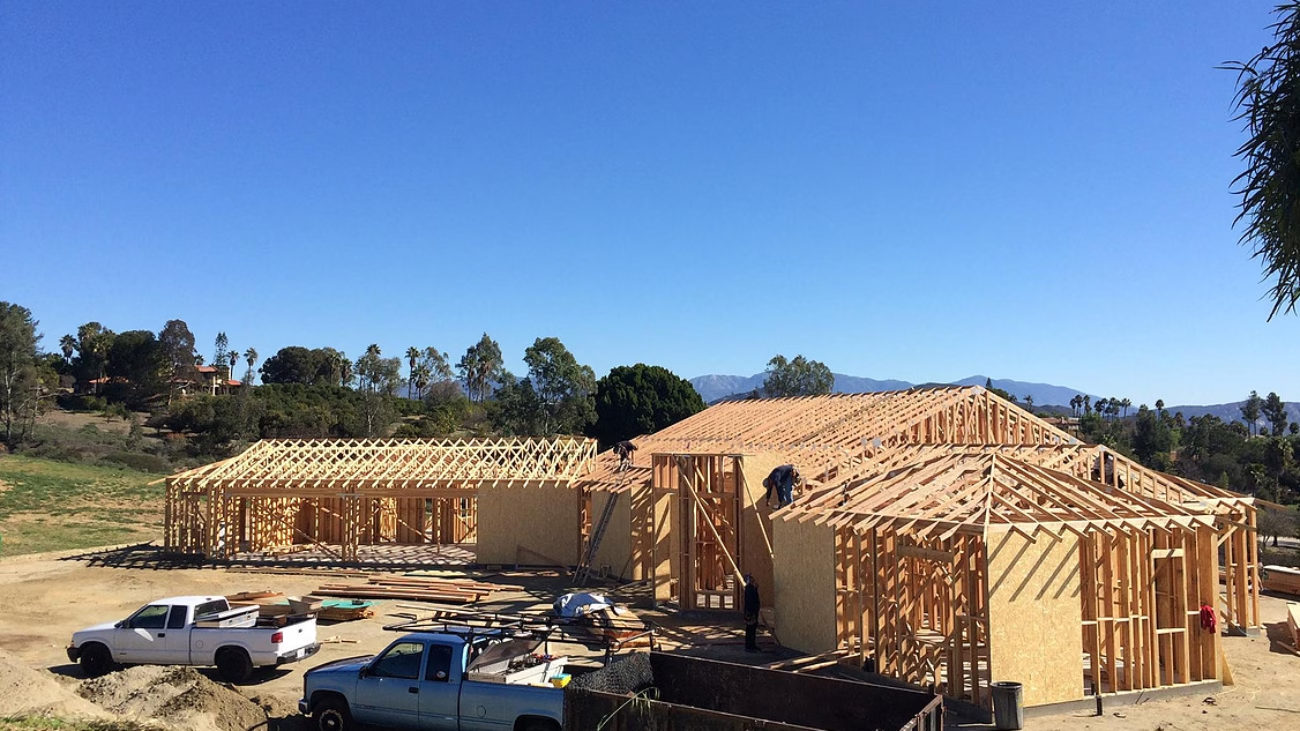
san diego truss manufacturer

How Much Weight Can A Roof Truss Hold?

Roof trusses are some of the strongest structures ever designed by man.  Based on ancient designs that supported huge domed roofs, today’s wooden trusses are built to hold up incredible amounts of weight.  While residential roofing trusses are not as strong as their steel cousins that hold up large suspension bridges and other structures, they can still hold up a great deal of weight without being compromised.  Just how much weight can a roof truss actually hold, and how strong can a roof truss be for a residential application?

Roof Trusses, Strength and Load 

Before talking about how much weight a roof truss can hold, it is important to understand the difference between strength and load-bearing capacity.  Load is simply the amount of weight a structure can support from a given direction.  From this perspective, trusses are extremely strong and are able to hold up roofing materials of almost any weight, including tile, stone and slate.  However, what most people mean when they ask how strong a truss is, instead of how much weight it can bear from the top, is how much strength it will exhibit in the face of high winds, which may cause twisting or stress to come from more than one direction.

Roof trusses can bear heavy loads from the top because they transfer the weight load downward and outward to the load-bearing walls of the building.  The chords inside the trusses channel the stress of the load away from the main beams and downward, causing it to dissipate.  Stress is always deflected better when chord members act together.  When too much stress is placed on a single member, particularly in a single spot, you can have cracking or breaking.  Trusses avoid this problem by dissipating that force over a much larger number of members.

However, there is more to calculating load than this.  Trusses actually carry two types of loads:  live loads and dead loads.  Live loads are temporary loads such as wind, precipitation, or someone walking on the roof.  These loads are brief and are quickly gone.  Dead loads, on the other hand, including the roofing materials and other structural weight that is present at all times.

Therefore, California publishes a table of both live and dead load requirements for inhabited and uninhabited spaces.  This helps builders determine if their trusses are up to code for required load limits.  In most cases, truss companies build to well within these requirements to account for unexpected live loads such as sudden high winds or storms.  In areas where heavy snow is possible, different limits may be in effect.

How Can I Be Sure My Truss Roof Is Strong Enough? 

The best way to navigate the complicated world of truss load and strength calculations is to work with a reputable truss builder who consistently provides quality products.  At Stone Truss, we have been working with San Diego builders for decades to provide the very best in roofing and flooring trusses.  Give us a call today to learn how we can help you meet codes and build strong, beautiful structures that will stand the test of time!

Truss Manufacturer San Diego

Gable vs. Hip: Which is Better for Truss Roofing?

The two most popular styles of roofing that utilize wooden trusses are hips and gables.  Both styles have advantages and disadvantages, and both can ultimately be a good choice for a home depending on the owner’s needs and preferences.  Either style can be strong and well-built using quality wood truss products, which will significantly reduce the cost and time spent on either style of roof.

Hip vs. Gable:  What’s the Difference? 

Hip and gable roofs are both quite common in today’s homes.  Gables, which feature two flat faces that form an “A” shape, may be slightly more common, especially on smaller homes, but hip roofs are often seen in areas where homes are custom built.  A hip roof has four sloping sides that meet at the top in a ridge.

From these basic definitions, there can be many variations.  For hip roofs, some of the varieties include:

  • Pyramid hip. This is the simplest type of hip roof which creates a single peak at the top.  It is named for its pyramid shape and is often repeated in different sizes for a custom roofing look on a home.
  • The mansard features two slopes on each side of the roof, with the bottom slope being steeper than the top.  A variation of the mansard, known as a combination roof, reverses this and flares the bottom slope wider than the top.  Both looks are popular in architectural styles that mimic certain historical periods.
  • Hip and valley. A hip and valley roof is simply a series of hips that include low-lying areas known as valleys.  Care must be taken in constructing this type of roof to allow for proper water drainage so that rain and snow do not build up in low areas.

For gable roofs, varieties can include:

  • Open or boxed gables. Most gables are either open at the end or closed in, with the roofline extending beyond the end of the gable.  These are known respectively as open or boxed gables and are common on ranch homes built in a straight, rectangular footprint.
  • Cross gables. Another common method of utilizing gable roofing is to have gables make right angles to each other, forming a cross or even an L-shaped home.
  • Gambrels and saltboxes. When gables are made with irregular shapes, the gambrel or saltbox is the result.  Gambrels are reminiscent of barn roofs, while saltboxes are popular on one-and-a-half story styles that slope down sharply in front but leave room for a second floor in the back.

Advantages and Disadvantages of Hips and Gables 

Both hip and gable roofs have advantages and disadvantages, based on their structure.

Advantages of hip roofs:

  • Better performance in high winds. Because hips do not present a flat end surface to the wind, they are less likely to suffer from shear in high wind situations.
  • Easier to build. Hip roofs are often easier to build than gable roofs and save time on construction jobs.  However, they often cost more than gables.
  • May save on insurance. Some insurance companies give slightly lower rates for hip-roof houses because of their resistance to wind and stress.

Advantages of gable roofs include:

  • Better snow performance. Gables are often used in cold-weather climates because they can handle snow load much more readily.
  • Less expensive. Gables are usually cheaper to build than hip roofs, depending on size.
  • More attic room. Gables offer more opportunity to utilize attic space, since headroom is more consistent throughout the roofline.

If you are considering a new roof or building project, let the professionals at Stone Truss help you decide on the right roofing trusses to make your job easier!  We can offer you experienced advice on choosing the right trusses for your job.  Give us a call today!

32b2fc_340242c94939479487d0d10a207fae4c~mv2_d_2048_1536_s_2

Wood Truss Terminology

Many people have heard of wood trusses and know that they may save a great deal of time and money for builders on many different job types.  Whether the construction involves a small home, a commercial building, or even a large apartment complex, trusses are often used to cut the cost of materials and labor compared to conventional framing.  However, even though many people know that trusses save money, they may not understand the basics of what trusses are made of or how they work.  In fact, many people think that a truss building is quite complicated and that trusses are extremely difficult to design and build.

In reality, trusses are relatively simple structures that, nevertheless, are incredibly versatile and functional.  The basics of a truss roof allow for almost limitless variations, making roof trusses one of the most adaptable components on a construction job.

What Is A Wooden Roof Truss and How Is It Built?

A wooden roof truss is, at its simplest, are pieces of wood connected with metal plates and either nails or screws.  Some form of truss construction has actually been used for thousands of years, but the modern truss has been produced since about the 1960s.  By making trusses very uniform and easy to create, mass production was made possible. 

Wooden trusses that are connected with metal plates are by far the most common type used in residential applications.  The lumber used is typically 2 x 4 or 2 x 6 timber, often Doug Fir or Spruce Pine.   

The Parts of the Truss

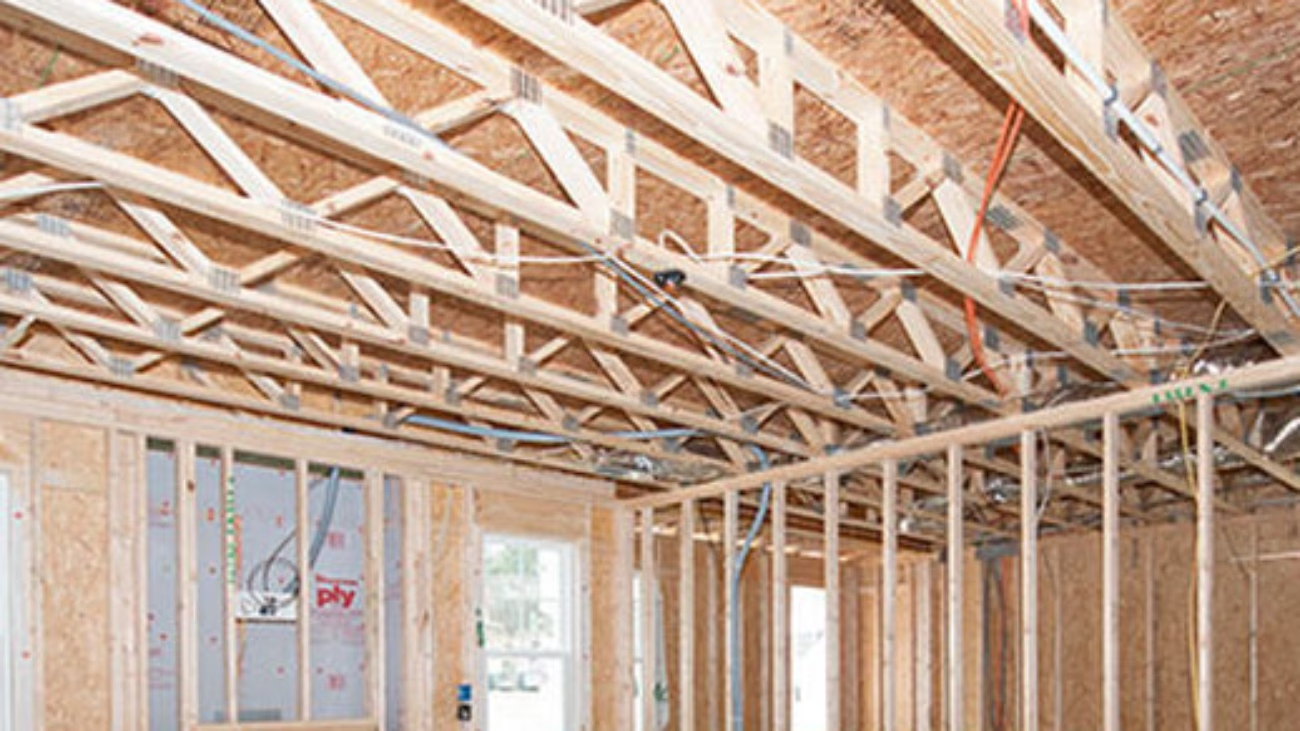
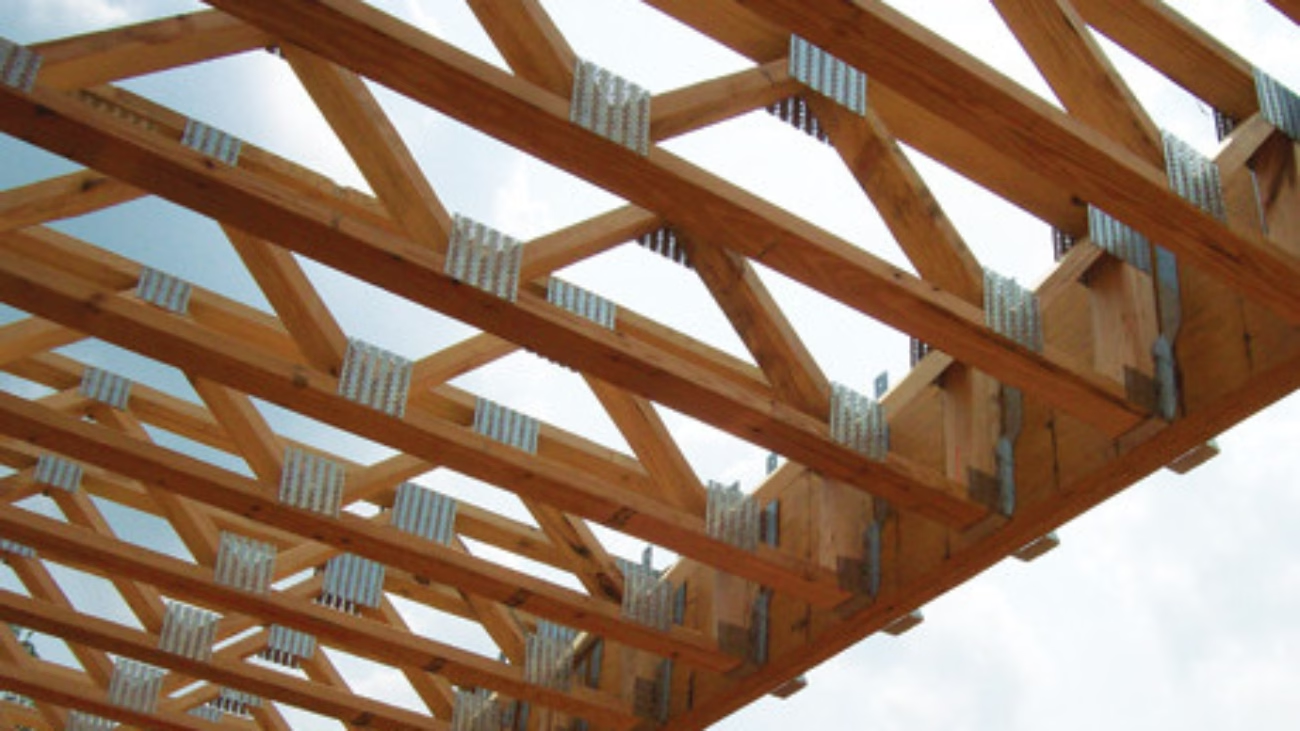
A truss generally has three sides which make up its perimeter, although specialty trusses may have more.  The typical truss has a triangular shape made of members called “chords.”  Between these, a varying number of pieces called “webs” connect each of the chords together.  These are all held together with toothed metal plates that are pressed or screwed in place.  Once a truss is fabricated and put together, it is incredibly strong.  The metal plates provide security and anchoring, while the wood allows for a certain amount of flexibility, meaning that trusses can bend and flex to a degree in high winds or under stress, avoiding breakage.  Truss roofs often last for many years thanks to this durability.

Trusses are typically categorized two ways:  as parallel chord trusses, which are used in flooring or for flat roofing; and in the more common pitched chord trusses, which are used for sloped roofing.  With pitched chord trusses, variations in the angles of the members can create any roof pitch needed, allowing builders a wide range of creativity in roofing options. 

If you want to know more about truss roofing or flooring, the professionals at Stone Truss are happy to help!  Give us a call today to learn more about how we can help you save money and time on your next building project.

Trusses vs. Rafters: The Real Cost Breakdown

You have probably heard at some time or other that trusses cost less than rafters as a roof framing option.  Is this really true?  If so, how much less do trusses cost?  More importantly, why is there such a cost differential between trusses and rafters, and given that this difference exists, why do people choose rafters over trusses in some situations?

Why People Choose Trusses Over Rafters–and Vice Versa 

People most often choose trusses over rafters for three reasons:  durability, ease of installation, and cost.  Trusses are built to withstand much greater forces than many rafters, making them ideal for areas with high winds or other adverse weather conditions.  Furthermore, trusses are very easy to install; often, a truss roofline can be completed in a single day, even on a relatively large home or office building.  Finally, trusses are almost always cheaper than rafters in overall cost.

However, there are some applications in which builders believe rafters may be a better option.  These are often custom roofing jobs in which the spaces are hard to reach or the roofing must be handmade to fit an oddly-shaped space, or in which there are last-minute changes to a plan that necessitate “on the fly” roofing.  However, in most cases, trusses can be built to accommodate almost any roofline, so pre-ordering trusses is almost always the better option.

Trusses truly save money over rafters in a number of ways.  The reason that trusses cost so much less include:

  • Trusses use less material. One of the biggest problems with stick-built rafters is that they use far more material than pre-made trusses.  Waste can become a huge issue at building sites.  Not only does the builder have to buy more material to account for waste, but the cutoff material must then be disposed of, often at additional cost.
  • Trusses use less labor. Labor costs are a significant portion of any building budget, and trusses can save tremendously in terms of the hours needed for installation.  This can end up saving the builder a significant amount of money over the life of the project.  Because trusses can be installed by fewer workers, labor costs are reduced; furthermore, the skill level required to install trusses is generally less than that required to build rafters, allowing skilled crafts people to spend their time elsewhere on the job.
  • Trusses require no storage. Builders can easily avoid storage fees and other costs associated with protecting and storing materials on the job site over a long period of time by buying trusses.  Trusses are built to order and delivered on demand, allowing the builder to choose the time and place.  This lets the builder have control over inventory without the need for expensive storage options.

At Stone Truss, we have spent decades producing quality truss roofing and flooring products for our San Diego area customers.  With years of experience, our company has come to represent a trusted name in trusses throughout southern California and beyond.  We deliver well-built products on time to your building site, and our professionals can support you throughout the process with timely and knowledgeable answers to your questions or concerns.  Give us a call today to learn more about the Stone Truss difference!