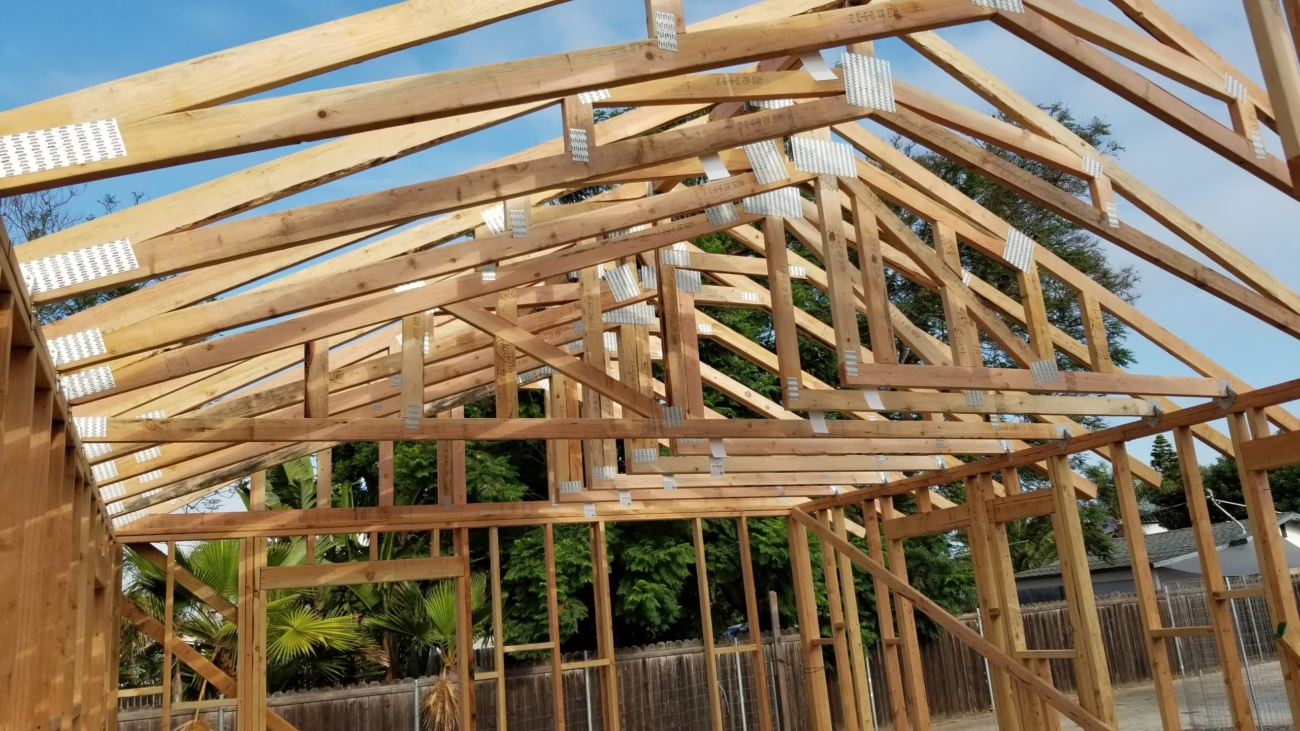
TRUSS1

Building Creative Rooflines With Truss Construction

While Trusses are often used to speed up building time, particularly with homes or businesses that need very similar roofline construction, trusses can create unique, beautiful roofs as well.  The idea that truss builds must be boring and “cookie cutter” is simply not true.  With a good design, any truss application can be created that gives your project beauty and appeal as well as function, convenience and cost savings.

Building Creative Rooflines

Many builders think of trusses as a great solution for simple gable-style roofs that run the span of a home in one direction.  Of course, his is one of the easiest roofs to construct and is therefore often used to keep building costs low.  However, trusses do not have to be limited to the same old boring rooflines.  They can also be designed and built to give your project aesthetic appeal.  Some examples of ways you can use trusses to quickly create beautiful, unique rooflines include:

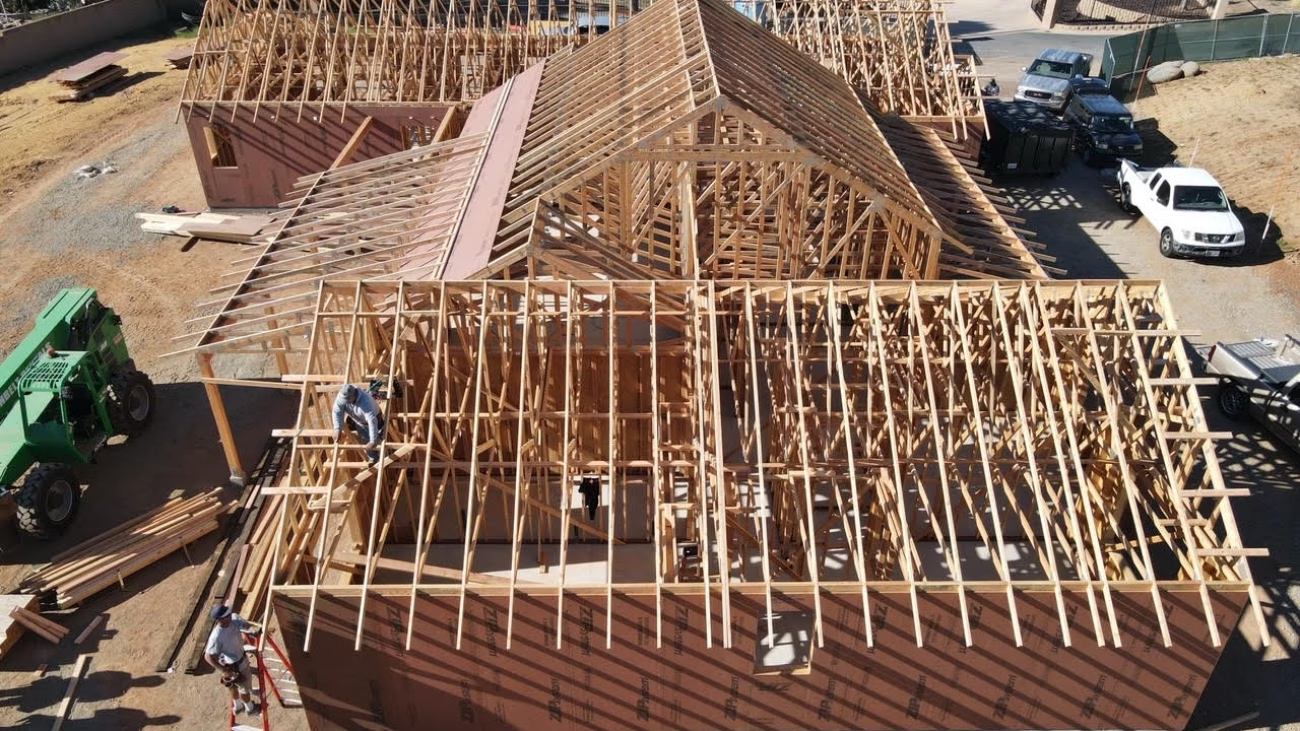
  • Hip roofs. Trusses are not only suitable for gable roofing.  Hip roofs are also a great choice for trusses, which make constructing hips very fast and simple.  Hips are often used, especially in varying sizes, to give multi-level rooflines such as those found on cottage or chateau-inspired plans.
  • Flat roofs. In San Diego, the architecture of many homes and businesses is inspired by Central American, South Western and Spanish styles.  Many of these include flat rooflines that draw attention away from the roof and to the beautiful stucco walls and courtyards that are the hallmark of these styles.  Flat rooflines can be very difficult to build correctly while incorporating the proper slope for drainage, but truss construction solves that problem quickly.  Builders can create a lovely flat roof that is also functional and reliable.
  • Gambrel or Bowstring styles. Some styles rely on generous curves and slopes to create a barn-like effect.  These types of roofs, usually in the gambrel or bowstring style, may also serve another function:  they offer under-roof space in attics for future expansion of living space.  Gambrel or bowstring trusses make it easy to construct these types of rooflines quickly, whether the purpose is to gain immediate square footage or simply prepare for future additions.  Homeowners often find it a great selling point when a house has the possibility of easy future additions at a relatively low cost.

At Stone Truss in San Diego, we have spent decades creating the right truss roofing and flooring solutions for our customers.  Our professionals can help you design the right trusses for your needs, the build them with quality materials and deliver them to your building site on demand.  With our professional, quick and affordable services, you can utilize the many benefits of truss roofs and floors at a price that will keep you within your building budget and ultimately improve your bottom line. Give us a call today at (760) 967-6171 to learn more about how Stone Truss can help you with your next building project.

Wood trusses San Diego

The Many Shapes of Roof Trusses–Gables

There are many different shapes and styles of roof trusses, and what you choose will depend on your specific building needs.  Some shapes are more suitable for certain applications than others.  You will also want to choose your roof trusses based on the look you want for your structure. 

It can be difficult to choose the right truss type for your build, so here is some information to help you. 

Gables–The Most Common Type of Truss 

The most common type of truss available is the gable truss.  Gables are traditional triangular trusses that include a certain number of webbing members or central posts.  The number and direction of the central webbing member will determine the particular type of gable truss you are using.  Gable roofs, also known as peaked or pitched roofs, are the most common in American construction, offering a cost effective alternative to more elaborate construction.

  • King Post. A king post truss is one of the simplest forms of gable truss, consisting only of a triangle with a central post holding up the apex of the shape.  This simple truss is useful when you simply need to hold up light roofing material, as with a shed or other small structure.  It is not suitable for most housing projects, although variations can be built that will hold more load.  The advantage of the king post truss for smaller buildings is that it is relatively inexpensive, using far fewer materials than other types of trusses.
  • Queen Post. A queen post truss is similar to the king post, but adds additional members between the king post and the outer edges of the truss.  This provides much more support, so the queen post truss can hold a larger load.than simple king post trusses.
  • Howe and Double Howe. The howe and double howe trusses are similar to the queen post in that they employ a central king post structure, but instead of a single central member on each side, the members are supported by smaller members that lie parallel to the king post.  This configuration offers durability and strength, and also allows the truss to stand up to torsion from wind. 
  • Fink and Double Fink. The fink and double fink trusses are different from the king post, queen post and howe models in that they use angled members across the span of the truss rather than building off a central king post.  This allows the trusses to have incredible flexibility in all directions, and makes them a good choice for applications in which high winds may be an issue.

If you are looking for the right trusses for your building project, look no further.  Stone Truss has been creating quality roofing truss products for decades for builders throughout the San Diego area.  Give us a call today to discuss your truss roofing needs with one of our professionals, and see how much we can help you save time and money on your next building project!

wood trusses san diego

How To Plan for Construction in 2022

The past year has brought many challenges for the construction industry.  Skyrocketing prices of materials and a significant reduction in labor availability have contributed to make 2021 one of the most challenging years on record for southern California builders.  At the same time, however, there is a record demand for new housing and businesses which must be met by intrepid builders who are not afraid of changing markets and patterns. 

Those who survive these winds of change all have something in common:  they utilize the best techniques and settings to optimize their production while simultaneously lowering their costs.  They do not sacrifice quality but instead find workarounds and more effective ways of getting the job done.  For many builders, this means finding ways to streamline and speed up the construction process while, at the same time, delivering solid, reliable results.

How To Plan for 2022 

If you find yourself caught between the rock of rising prices and the hard place of labor shortage, you are not alone.  A recent 20 percent surge in construction in southern California alone has driven great changes in the industry. Ultimately, builders are faced with a dilemma:  control costs while delivering even more product in a shorter amount of time.

As you plan for 2022 construction, there are several things to keep in mind:

  • Building costs will fluctuate. Between the pressures of inflation, supply chain issues and overall rising costs, builders will be faced with more expensive materials. For builders who do not want to cut quality, prices will have to rise.  Controlling these costs should be a paramount consideration for any builder; simply using old standards of costs for materials will not work in the long run.  Even temporary decreases in prices may not last.  It will be better, throughout 2022, to assume that prices will stay at record costs when compared to earlier years.
  • Supplies are limited. Because of fluctuation in the supply chain, it is important to understand that time for completing of construction will be longer.  While supply chain issues may be resolved sooner rather than later, it will take some time for this backlog to work itself out.  Count on a bit longer to receive materials so that you do not give false hope to clients.
  • Utilize streamlined techniques. One of the best ways to balance rising costs and fewer materials are to find ways to streamline your building approach without sacrificing quality.  For example, using truss roofing, delivered on demand to your site, can help you stay on budget and on target with your building requirements.

At Stone Truss, we have been working to support builders in southern California for many years with high-quality truss products.  We can help you deliver on your building promises to clients in 2022 with quality truss roofing and flooring products.  Give us a call today to find out how we can help you build better, faster and with less cost in the coming year!

IMG_0915

How To Determine Truss Strength

One of the primary considerations when building a truss roof is how strong the trusses will be.  Strength is measured not only in how much load the roof can hold but also in how well trusses stand up to shear, torsion and other factors.  The stronger the truss, the higher wind speeds and twisting forces it can withstand.

How To Calculate Roof Truss Strength 

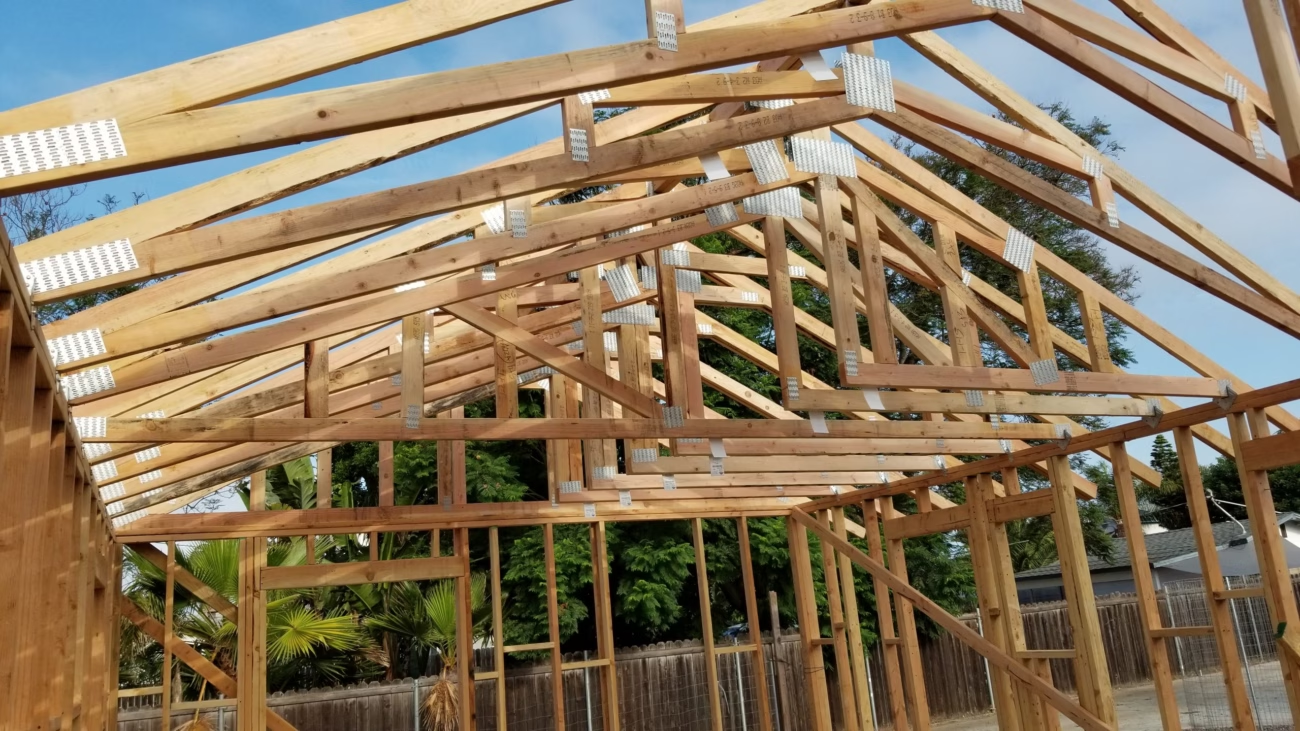
Trusses are created from wooden members.  Members are pieces of wood that are connected together with metal plates to form triangles.  The locations where the pieces meet are called “nodes.”

In order for roof trusses to create a stable load distribution, it is important that the truss include support nodes.  This is done by assigning two nodes on each truss as “support nodes.”  These two nodes, once identified, can be used to calculate the load-bearing capability of the truss.

One of the support nodes functions as a “fixed” node.  This means that the truss will be secured and will not move at that point.  The other is designated a “rolling” node which can move in wind, an earthquake, or other stressors.  It is important to have some flexibility in trusses to prevent them from breaking when stress is applied.

A formula is now applied to the truss to calculate load strength.  The formula, which can be written as M+3=2*N, says that the number of members of a truss plus 3 must equal twice the number of nodes.  When both sides of this equation are equal, the roof is stable and can support stressful loads.  If these numbers are not equal, the truss will be unstable.  This means that more nodes must be added in order to achieve stability.

Once stability is established, any load placed on the load-bearing node will be offset by equal force from the other nodes. 

Why Are Trusses a Better Choice Than Rafters for Roof Strength? 

Rafters were the primary choice for roof design for many centuries, and they obviously worked.  However, once engineers realized how much stronger trusses could be made, a truss roof quickly outpaced traditional stick-built rafters in the percentage of homes and businesses which use them.

A truss roof offers a number of benefits besides better strength and stability over rafters.  A truss roof often saves significantly on building costs, because trusses are much easier to pre-build and deliver to a job site, where they can be installed quickly and with fewer workers than required for stick-built rafters.  Additionally, avoiding storage costs and problems on the job site by ordering trusses dropped on a particular date is a big benefit to many builders.

If you are interested in learning more about ordering prefabricated trusses for your next building project, contact Stone Truss today.  Our experts can help you choose the right trusses for your construction needs and will build them to order, as well as have them delivered at a designated time.  Build a stronger, safer and less expensive roof for your next building project with the help of Stone Truss!